
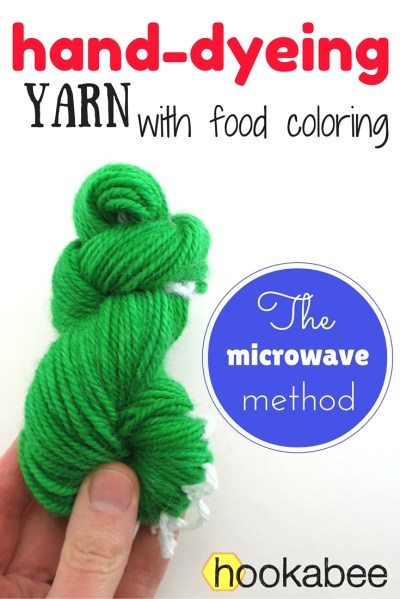
 This is the fourth post in a series I am doing on how to hand-dye yarn using food colouring. Previously, (1) I harnessed the heat of the sun to dye a small skein of yarn bright yellow, (2) slow cooked my yarn in a crock-pot until it was a gorgeous pink, and (3) turned a bit of yarn teal right on the stove top. This time I am going to show you how I used the microwave to dye my yarn green.
If you missed the first post on hand-dyeing, make sure you read at least the first section on the basics of dyeing with food colouring and how to prepare your yarn.
Hand-dyeing using the microwave:
This method is the fastest and is super easy, but you have to watch out and make sure you don’t burn your yarn. It is possible to overheat your yarn and burn it when using a microwave if your yarn isn’t wet enough, especially if you aren’t familiar with the strength of your machine. If your yarn has enough moisture, however, this shouldn’t be a problem!
This time I chose the Kelly Green dye from my box of 12 Wilton Icing Colours to dye the little 25 g skein of alpaca wool yarn I had made during my first dying experience.
My microwave dyeing protocol: (using 25 g of yarn)
- I pre-soaked my yarn for about 30 min in a bath made up of vinegar (2 tbsp) and water (2 cups). I used these volumes because my dye is green (so needs more vinegar than yellows and reds, see DyeYourYarn.com), and the total volume was able to cover my yarn fully.
- In a one pint glass mason jar (just needs to be microwave safe), I mixed 1 cup of water with 1 tbsp of vinegar and some Kelly Green Wilton icing dye. I just estimated the amount of dye, but used no more than 1/4 tsp because I didn’t want extra, and therefore wasted, dye that wouldn’t be taken up by the yarn. I based this on the info found on theDyeYourYarn.com site for Wilton dyes: “[Use] 1/16 teaspoon Wilton®Icing Gel on .2 oz Lion Brand® Fishermen’s Wool. This amount of gel produces a saturated dyebath. Using more gel will leave food color in the dyebath that will not bond.” I then whisked the solution until most of the gel clumps were gone and dissolved.
- Next, I transferred the wet yarn from the pre-soak bath into the jar. Before you transfer your yarn, make sure that your two baths are not drastically different in temperature. This reduces the chances of your yarn felting.
- I then placed the jar with the yarn in the microwave, cooked it on high for 1 minute, then checked it to see if all the dye had been absorbed. I repeated this process (microwave for 1 min, check dye bath) until no more dye remained in the surrounding water (which means all the dye has been taken up by the yarn). At each check, I mixed the yarn around a bit so that my yarn would have even colour. After just three minutes of heating the water started to boil, so I let it sit for some time before heating the yarn further.

- After the dye had all been absorbed, I left the yarn in the jar and allowed it to cool to room temperature.
- Once cooled, I removed the yarn and rinsed it to remove any excess dye. You don’t want to suddenly rinse your hot yarn with cool, or even warm water, because this may cause your yarn to felt, so make sure your yarn is completely cooled before this step. Once rinsed, I gently squeezed the excess water out and hung the yarn to dry.
In the end, my yarn came out a gorgeous deep emerald green:
 How does using the microwave compare to my other dyeing experiences? I think I may have used too much dye in this case. I needed to heat the yarn so much the dye bath started to boil before all the dye had been absorbed. Once I let the yarn sit and cool down, a lot of the dye was absorbed, but still not all of it, so I needed to do yet another bout of heating. In the end though, I was satisfied with the great colour saturation and how easy and fast it was to use the microwave over the other methods.
So, I have tried all four methods of heat setting dye: solar heat, slow cooker, stove top and microwave – and which is my favourite? I think I will mostly be using the microwave in the future. It was so easy and fast! I would consider using the heat of the sun again, however, on hot summer days – it doesn’t use up as much electricity!
Don’t forget to sign up for my amigurumi newsletter to receive emails filled with ami fun. You can also follow me on facebook, twitter, instagram, and pinterest to keep up to date on all things hookabee.



 hookabee


4 responses to “Hand-dyeing with food colouring: Microwave method”
What a beautiful colour.
Thank you! I love it too 🙂
This is a very useful post. I have always wondered how to use the microwave for dyeing yarn. Now I know! 🙂 Thank you
Oh yay! Glad it was helpful 🙂